
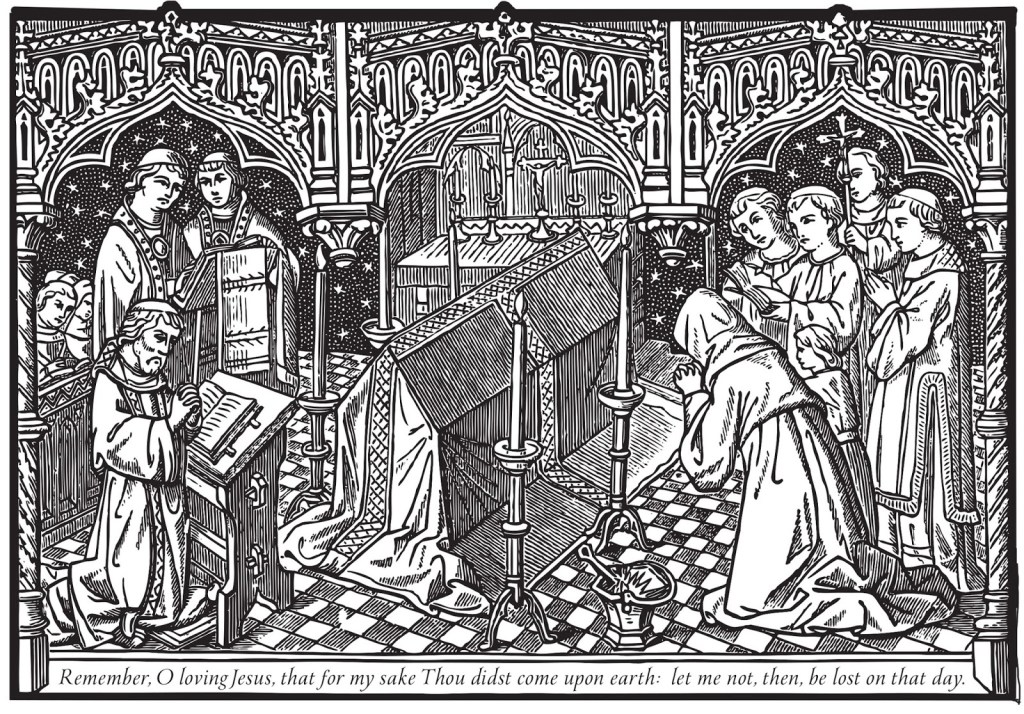
Many Catholics experienced the transition from Latin mass to vernacular mass after Vatican II as a traumatic shock. This trauma was borne from a break in the power of religious institutions, leading many to have a crisis of faith; rendering once hallowed rituals seemingly useless to the eyes of many traditional Catholics. The push for liturgical renewal from laypeople comes from a desire to once again view the church as invested with the power of the Lord, and from churchmen as a way for the church to show that it can wield the power of the Lord. What is clear in both of these cases; is that holding a secret is powerful, and the strictness and secretiveness of Latin mass is a way to hold on to the secret that the church only has power when people believe in it.
The structure and language of Christian mass has been changed numerous times throughout the centuries. The first Christian masses were most likely in Syriac, as that was the local language of the participants (Sawyer 37). It was not until much later in the history of Christianity that mass was regularly celebrated in Latin, as the language was thought to be a paltry servant to Greek until it had developed its own vocabulary for worship and philosophy in the time of Constantine in the fourth century (Sawyer 39). It was from this time on that mass in Rome was celebrated in Latin. Once the churches separated into Roman Catholic and various forms of Orthodoxy and other Catholic denominations, the Roman Catholic Church continued using Latin rites as it had since the 4th century (Kenis 13). This imposition of Latin across all polities from the church was not by any decree; it was an imposition in the sense that there were no translations of liturgy into languages other than Latin that were available or allowed. There were, however, other forms and rites of mass that were celebrated locally until the 16th century when Pope Pius V issued an encyclical entitled Quo primum (Pius V), which codified the particular rites and rituals of the Latin mass that lasted until the 1960s. Latin was never, and never has been, formally recognized by the church as a holy language, such as Arabic in Islam, or Hebrew in Judaism. There exists no holy language in the Catholic tradition; in fact, having no holy language is integral to the missionary aspect of Christianity. The story of Pentecost from Acts illustrates this quite well. In order for the Apostles to spread the Gospel, they were filled with the Holy Spirit, which allowed them to speak in all the languages of Jerusalem. This is supposed to have allowed them to begin their missionary journey (Acts 2: 4-21 The New Jerusalem Bible). With this in mind, it is clear that the idea of a holy language is generally foreign to Christianity. One cannot help but ask why a change in liturgical language would be so frustrating to worshippers if there were no holy language. To see why this is so, one must find the church’s motivation for imposing the change from Latin to vernacular mass.
In the mid 20th century, the church was rapidly losing influence and authority; modernization was sought as the solution (Carbone). The hope was that modernizing their services would attract more young people, and give the church back the influence that it once had over daily life. This desire for influence was not solely a desire for power, rather the church thought that it was spreading the word of God and people were ignoring it to their peril. One of the most contentious changes was the updating the liturgy to have less ceremonial rites, including the use of vernacular language as opposed to Latin. This change had unintended effects for the church. Whether or not they gained or lost congregants since the reform, in the eyes of many traditional Catholics, the church turned its back on tradition, and let their hold on interpretational issues slip. In allowing for vernacular mass, the church lost their symbolic power. The church, supposed by some to be above all worldly things, introduced guitar-based music at mass instead of chanting or organ music, mass in vernacular instead of in the ‘holy’ language of Latin, and even the loss of some traditional vestments for priests. Traditional Catholics took all of this as a sign of worldly concerns creeping in on church matters. They argue instead for a return to an even stricter, more dogmatic Catholicism, a return especially, for Latin mass.
Of course, this is not the first liturgical reform in the Christian tradition, and not even the first in the Catholic tradition. The power to change the liturgy was of great importance for the medieval church as liturgical reforms have great power in religious societies. In early medieval Francia, for instance, the language of the liturgy formed the basis for the ideology of the crusaders (Gaposchkin 30). Reforms and new prayers were added to the liturgy to pray for the crusaders and pray against the Turks (Gaposchkin 226-227). This was part of the motivation for people to go on crusades. Once in Jerusalem, there are reports of crusaders forcing the local clergy to use the Frankish Latin liturgy (Gaposchkin 133). The clergy of Jerusalem would most likely have been celebrating an even older rite than the Frankish one, and certainly it would have been in a closer language to the original language of Jesus. Most holy languages have some relationship to the language of prophets, and it is clear that Jesus did not speak Latin. Although there is no holy language in Christianity, it is clear that language holds power, and in religious societies, the language of worship is of the utmost importance. According to Pierre Bourdieu, the power of the liturgy is derived from the power invested in it by the people, when people can no longer recognize religious rites as they are used to; the rites and institutions attached to them lose power (Bourdieu 73). It is clear that the problem is not solely that the liturgy has changed, as that has happened before, and had positive impacts on the aims of the church, for example, in the time of the crusades. The issue is the change of language. Latin is not an officially sacred language in the Catholic, but for some worshippers it feels like it is.
There are many factors that play into the making of a sacred language, and their impacts on their respective religions vary widely. One important aspect is certainly who is allowed to say or learn the sacred language, and whether the learning of this language by lay people is encouraged, discouraged, or simply not at issue. Certainly in the tradition of Latin liturgy the learning of Latin by lay people is not encouraged, but it is not forbidden or discouraged. The resources simply did not exist for a long time, and even though they do now, the church has still not taken a position on whether lay people can or ought to learn Latin, as it is not a sacred language like Hebrew, Arabic, Sanskrit, or Avestan. In his book on sacred languages, John Sawyer writes, “unintelligibility plays an important role in binding the disciple to the master,” (24). The church was able to hold onto its authority through the use of an obscured language. Priests in Latin mass read the scripture in Latin, and then interpret it in vernacular for the celebrants. In fact many arguments for Latin mass over vernacular contend that the priest must do this, as if scripture readings were in vernacular languages, they would be too open to interpretation and would therefore invite misinterpretations. As the church’s political power grows over time this power over interpretation seems beneficial, and the argument for tradition can be used in its defense. The church gets viewed as an institution acting out the will of God; as such, it cannot err. Ignoring the large history of masses celebrated in other languages because they are not part of the tradition of the proper Roman Catholic Church, congregants see the church as having swayed from its original rituals. The church has thus admitted fault and error and, as a result, it has lost its power. The church, being an institution acting through God, takes great cares not to change. This is because if they admit a major change in what they do, they imply that either the word of God was wrong, or that they were wrong in interpreting it. In either case, these would be grave errors to make, and in the eyes of a great many traditional Catholics, a church with proper authority simply would not have made errors such as these. As Bourdieu writes, “the crisis of religious language … is part of the disintegration of an entire universe of social relations of which it was constitutive,” (116). In switching the language of mass away from Latin, the church further altered the social landscape that they were a part of, destroying the foundations that underpinned their authority.
The view that Latin is a holier language than any vernacular for mass is not the only view that expresses a preference for Latin mass. Another view is that the Latin mass better represents the sacrifice of mass, and thus gives better expression to ‘good violence’ (Uwe Michael Lang and Marr 36). Since the beginning of Christianity, “mass was an unbloody sacrifice, a re-presentation of Christ’s atoning work, and efficacious for the remission of sins,” (Uwe Michael Lang and Marr 42). The features this author takes as better representative of the sacrificial aspect of mass are all non-linguistic, but they are nonetheless a translation. In updating the mass for modern times the church omitted practices such as the priest facing away from the celebrants and toward the tabernacle, the presence of Christ. Instead, priests now face the congregants at mass, and the congregants look at the priest, as opposed to the Eucharist. This change is a very contentious one, and Marr argues that it takes away from the focus of the ritual, which is supposed to represent the sacrifice of Christ, by directing too much attention to the priest (Uwe Michael Lang and Marr 48-52). Even if this were the case, one wonders if Catholics might just add these aspects back into the mass and keep vernacular language. This could be a way to both maintain the vernacular mass, as well as giving traditional Catholics a taste of the domination they seemingly crave. While going back to the traditions of Latin mass with vernacular language is not part of any plans from the Holy See, maintaining control over worshippers definitely is. In 2021; Pope Francis issued an Apostolic Letter entitled Traditionis Custodes (Francis). In it he greatly restricts the ability for clergy worldwide to celebrate Latin mass. Some contend that he issued this bull to stem the rise of sedevacantism (Blanchard), or Catholics who believe that there has not been a valid Pope since before the reforms of Vatican II. Given the relationship between language and power in the church, one cannot help but wonder whether or not this tactic of heavy-handed domination will work, or if something else is motivating the sedevacantists.
The issue at stake is not so much why Latin is viewed as a holy language. Instead the issue is the ability of language to both signify and contain power within them. The language of Latin signified the power held by the church because of its use across the whole world, regardless of the local language. By submitting to the use of Latin and the authority of the church over interpretational issues, the congregants granted the church this power. The issue here is, in some ways, similar to the issues surrounding vernacular liturgy in the Reformation. The Protestants argued that the Catholic Church was not the infallible institution it claimed to be. This led to many crises of faith in the Catholic Church, with many Catholics joining various Protestant movements and turning to their interpretations of scripture over those of the church. A similar thing is happening now, and many traditional Catholics argue for a return to Latin mass because of its superior power to awe and inspire members. Language creates power, and when the language of power changes, the ability to hold onto power changes with it.
Works Cited
Blanchard, Shaun. “Traditionis Custodes Was Never Merely about the Liturgy.” Church Life Journal, University of Notre Dame, 2 Aug. 2021, churchlifejournal.nd.edu/articles/traditionis-custodes-was-never-merely-about-the-liturgy/.
Bourdieu, Pierre. Language and Symbolic Power. Polity, 1991.
Carbone, Vincenzo. “Vatican Council II: Light for the Church and for the Modern World.” Jubilee 2000, May 1997, http://www.vatican.va/jubilee_2000/magazine/documents/ju_mag_01051997_p-21_en.html. The Holy See.
Francis, Pope. “Apostolic Letter Issued ‘Motu Proprio’ by the Supreme Pontiff Francis ‘Traditionis Custodes’ on the Use of the Roman Liturgy prior to the Reform of 1970, 16 July 2021 | Francis.” Www.vatican.va, The Holy See, 16 July 2021, http://www.vatican.va/content/francesco/en/motu_proprio/documents/20210716-motu-proprio-traditionis-custodes.html.
Kenis, Leo. Alfred Plummer’s Conversations with Dr. Dollinger. Peeters Pub & Booksellers, 1985, archive.org/details/alfredplummercon0000plum/page/12/mode/2up.
M. Cecilia Gaposchkin. Invisible Weapons. Cornell University Press, 2017.
Pius V, Pope. “Quo Primum.” Papal Encyclicals, The Holy See, 14 July 1570, http://www.papalencyclicals.net/Pius05/p5quopri.htm.
The New Jerusalem Bible. Doubleday, 1985.
Uwe Michael Lang, and Ryan J. Marr. The Fullness of Divine Worship : The Sacred Liturgy and Its Renewal. The Catholic University Of America Press, 2018, pp. 33–56.
 OBJECTIVE COLLAPSE