

Post-apocalyptic, hauntological, and crypto-political. Rick Owen’s latest collection is all of the above.
The latest collection from Rick Owen’s debuted the first of this month and the fashion media has been all over it, so you’ll have to excuse my lateness in covering it. All the reviews that I have read of this collection praise it for the incredible way that it channels the current mood of doom and gloom into a “fabulous” and sexy collection. Mahoro Seward writing for i-d said, “defiance…can be fabulous…a counterpoint to the greyness and drear of current times,” (Seward 2020). This was achieved by the unconventional (for Rick), use of loud bright colours, sequins, and even (if you can believe it), patterns!

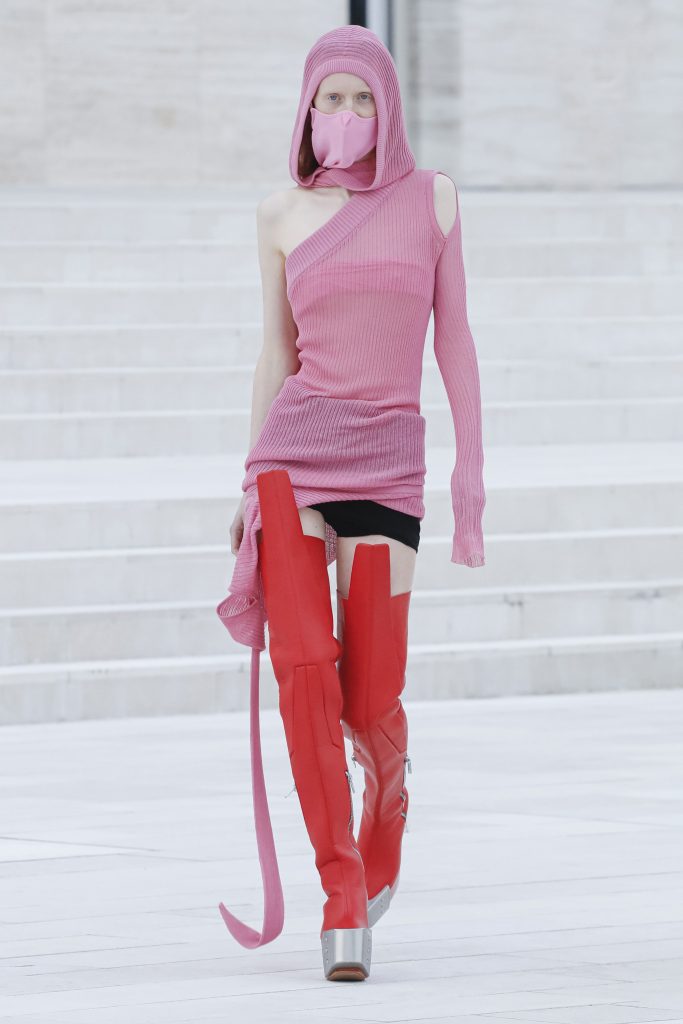
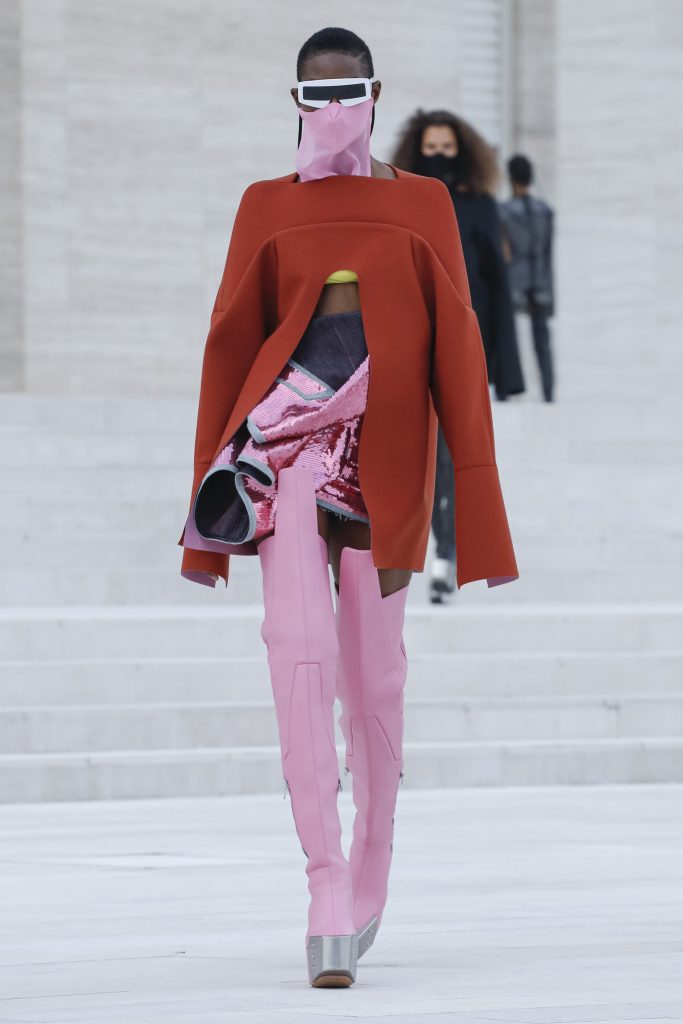

I think one crucially overlooked aspect of the show was the music choice. Rick says in the show notes,
“I USED A SOUNDTRACK OF DONNA SUMMER’S ‘I FEEL LOVE’ REMIXED FOR ME 10 YEARS AGO BY JEFF JUDD, MY LONGTIME MUSIC COLLABORATOR. THIS SONG HAS ALWAYS BEEN A REASSURING AND STABILIZING ANTHEM FOR ME BUT HERE IT GETS AS DARK AND DELIRIOUS AS FALLING INTO A K-HOLE, FITTING THIS MOMENT PERFECTLY.” (Owens 2020).
I believe the music is playing during the livestream version of the show (https://www.youtube.com/watch?v=su4mf6hmo18), as opposed to the music during the re-uploaded version (https://www.youtube.com/watch?v=RqhhObCG1No). Either way the choice of ‘I Feel Love’ to remix as a mood for this current moment is really interesting to me. It gives the entire show an explicitly hauntological tone from the beginning. As Rick says in his own show notes, the song is “AS DARK AND DELIRIOUS AS FALLING INTO A K-HOLE,” the interesting thing about this song is that when it came out, it was one of the most futuristic songs in existence, Brian Eno and David Bowie both declared it the future of club music (Reynolds 2017). For people of Rick’s generation (late Boomer/early Gen X), this song was a glimpse of the fantastic future of computers and humans coexisting and creating together. While the predictions about club music were correct, the future imagined and excitedly promised about the capabilities and status of computers never materialized. This fact is what is symbolized by Rick’s choice of music.
The other and more obvious signal that Rick gives us of his hauntological leanings is the inspiration for the clothes and aesthetic. The collection is very clearly inspired by 90’s/Y2K rave/cyberpunk/hacker aesthetics and culture, and the recent rave revival in the 2010’s in the former Soviet Union (CXEMA, etc.). Here’s some images for comparison.
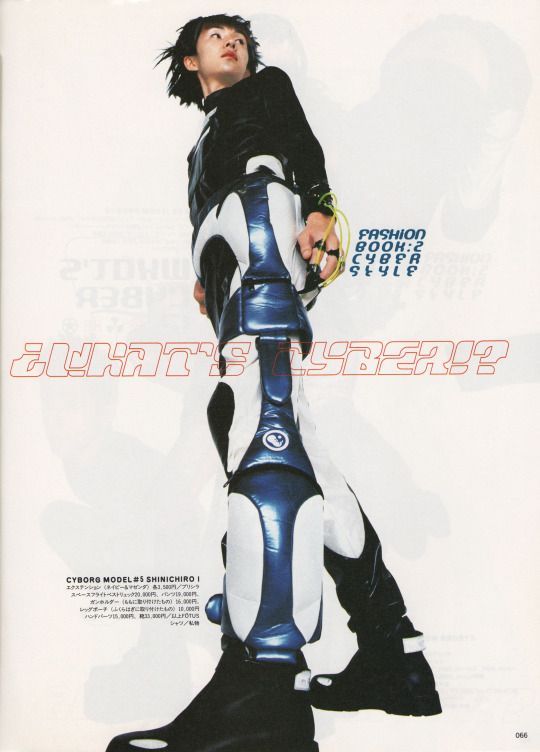



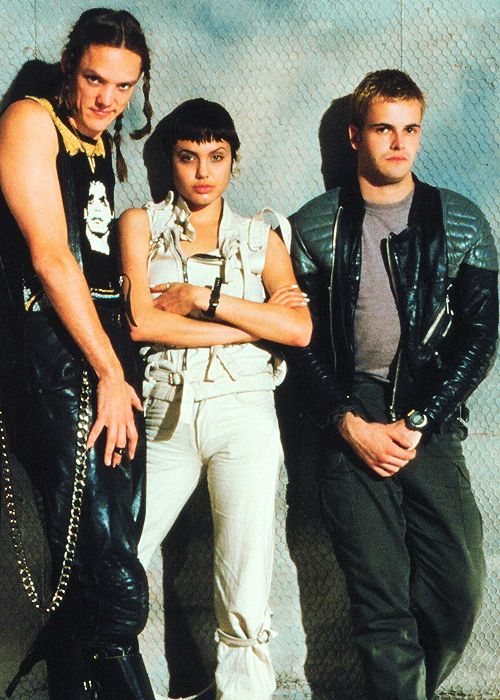

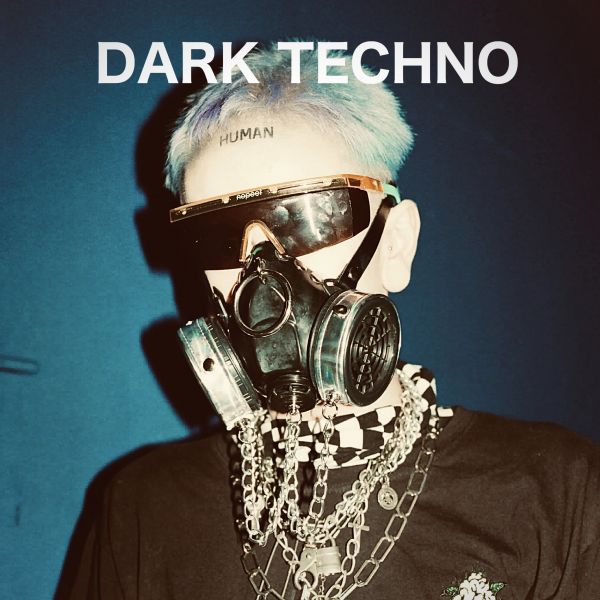

What I’d like to posit is that this aesthetic (cyberpunk, techno-futuristic, post-apocalyptic), is a direct result of the rise of neoliberalism and the fall of the Soviet Union and the “End of History” arguments that dominated the spirit of the 1980’s and 90’s. If what I’m saying is true, then Rick’s choice of inspiration for this collection is not simply hauntological, it is also a crypto-political statement.
The rise of neoliberalism and the fall of the Soviet Union in the late 80’s and early 90’s meant a shift – and not just for the Soviet Union. For the Soviet Union it meant shifting to a capitalist mode of production and societal organization, but for the rest of the world, the symbolism of the fall of communism is best summed up by Margaret Thatcher’s famous phrase; TINA, or “There Is No Alternative.” Capitalism settled into its place in the broad public consciousness as the only way forward and the only viable economic system. As a result of the popularization of capitalist realism, science fiction grew a mutant, dark, technological tumour – cyberpunk. Cyberpunk is always a vision of the future that is an accelerated present. The worlds are always hyper-capitalist, always either anarchic or totalitarian, always ecologically disastrous. The worlds of cyberpunk are meat grinders and the controllers of these worlds destroy, break, and modify the people that live in them and their environment for the sake of profit. Stop me if you think you’ve heard this one before. The worlds of cyberpunk are not dissimilar to our current world if it were accelerated, and that is because cyberpunk grew out of the anxiety created by the first major wave of capitalist realism.
The question that arises from the recognition of cyberpunk’s political origins is this: what does the revival of this aesthetic in Phlegethon signal or mean? I think the answer is quite similar to what the original rise of cyberpunk was responding to, namely, a re-recognition of the power of capitalism and a renewal of TINA-esque politics. In fact, the spirit of TINA has been echoed by both Angela Merkel in 2010 (‘alternativlos’), and David Cameron in 2013 (Robinson 2013). This second wave of capitalist realism (in the west at least) has its roots in a couple of very important political failures of the 21st century. The first is the failure of the Occupy movement. The second is the failure of the campaigns of both Bernie Sanders and Jeremy Corbyn. These campaigns or movements were the first since the fall of the Berlin wall that seemed to present viable challenges and alternatives to capitalism. The resulting failures re-affirmed the doomer conscious message, There Is No Alternative. To talk about why that is, we must first go back in time to the 80’s.
In his book Simulacra And Simulation, Jean Baudrillard says this about science fiction in late capitalism,
“Perhaps science fiction from the cybernetic and hyperreal era can only exhaust itself, in its artificial resurrection of “historical” worlds, can only try to reconstruct in vitro, down to the smallest details, the perimeters of a prior world, the events, the people, the ideologies of the past, emptied of meaning, of their original process, but hallucinatory with prospective truth… fiction will never again be a mirror held toward the future, but a desperate rehallucination of the past” (Baudrillard 123).
Fashion tells us a fiction, even if it is a fiction about the real world. As Mark Fisher says in Capitalist Realism, “Capitalist realism…entails subordinating oneself to a reality that is infinitely plastic, capable of reconfiguring itself at any moment” (Fisher 54). What these two quotes mean for Phlegethon, and indeed for the broader aesthetic framework that the show develops and rests on, is that although the aesthetics may look futuristic, or even retro-futuristic, they in fact are a product of our inability to think productively about the future. However, we are not trapped for no reason. We are trapped in this mode of thought because events have come about that produce these thoughts within us. Capitalist realism and the end of history are hyperstitions, and hyperstitions, “once ‘downloaded’ into the cultural mainframe, engender apocalyptic positive feedback cycles” (Carstens 1). Hyperstitions also affect the course of both history, and the future. Once they become accepted into the cultural framework they limit the ways in which we can view history, and the nodes of potentiality that are available as futures. In this way, hyperstitional ideas can be translated into real world-historical forces.
If it can be said that ideas of capitalist realism and the end of history are world-historical forces, then it is possible for them to be culturally contested/combated. So if the dominant idea about capitalism is that there is no alternative, then to contest it would be to present an alternative. In my mind, the Occupy movement tried to do that. It failed in actually becoming a great enough force to overcome capitalist realism, and the same can be said about both Jeremy Corbyn and Bernie Sanders’ campaigns. In this way, the failures of each of these movements or campaigns was essentially a cultural concession to the idea that there is no alternative, and we are living in the end of history. Reactions to this concession were similar to reactions to the first wave of capitalist realism, and the product of these reactions is the aesthetic vision of Phlegethon.
Bibliography
Baudrillard, Jean. Simulacres Et Simulation: Simulacra and Simulation: the Body in Theory. University of Michigan, 1994.
Carstens, Delphi, and Nick Land. “’Hyperstition: An Introduction’.” 0rphan Drift Archive, 25 Jan. 2020, http://www.orphandriftarchive.com/articles/hyperstition-an-introduction/.
Carstens, Delphi. “Delphi Carstens – Hyperstition.” Xenopraxis, xenopraxis.net/readings/carstens_hyperstition.pdf.
Fisher, Mark. Capitalist Realism: Is There No Alternative? Zero Books, 2010.
Jameson, Fredric. Postmodernism, or, The Cultural Logic of Late Capitalism. Duke University Press, 2007.
Owens, Rick, director. RICK OWENS PHLEGETHON SS21 WOMENS (LIVESTREAM). Youtube.com, 1 Oct. 2020, http://www.youtube.com/watch?v=su4mf6hmo18.
Owens, Rick, director. RICK OWENS SS21WOMENS – PHLEGETHON. Youtube.com, 5 Oct. 2020, http://www.youtube.com/watch?v=RqhhObCG1No.
Owens, Rick. “Phlegethon.” PHLEGETHON SS21, 1 Oct. 2020, http://www.rickowens.eu/en/US/collections/women-phlegethon-ss21.
Phelps, Nicole. “Rick Owens Spring 2021 Ready-to-Wear Collection.” Vogue, Vogue, 5 Oct. 2020, http://www.vogue.com/fashion-shows/spring-2021-ready-to-wear/rick-owens.
Reynolds, Simon. “Song from the Future: The Story of Donna Summer and Giorgio Moroder’s ‘I Feel Love.’” Pitchfork, Pitchfork, 29 June 2017, pitchfork.com/features/article/song-from-the-future-the-story-of-donna-summer-and-giorgio-moroders-i-feel-love/.
Robinson, Nick. “Economy: There Is No Alternative (TINA) Is Back.” BBC News, BBC, 7 Mar. 2013, http://www.bbc.com/news/uk-politics-21703018.
Seward, Mahoro. “Rick Owens Takes You to Hell and Back for SS21.” I, 2 Oct. 2020, i-d.vice.com/en_au/article/y3zywj/rick-owens-womenswear-ss21-review.
 OBJECTIVE COLLAPSE